VPN Troubleshooting (2026): Fix Common VPN Problems Fast
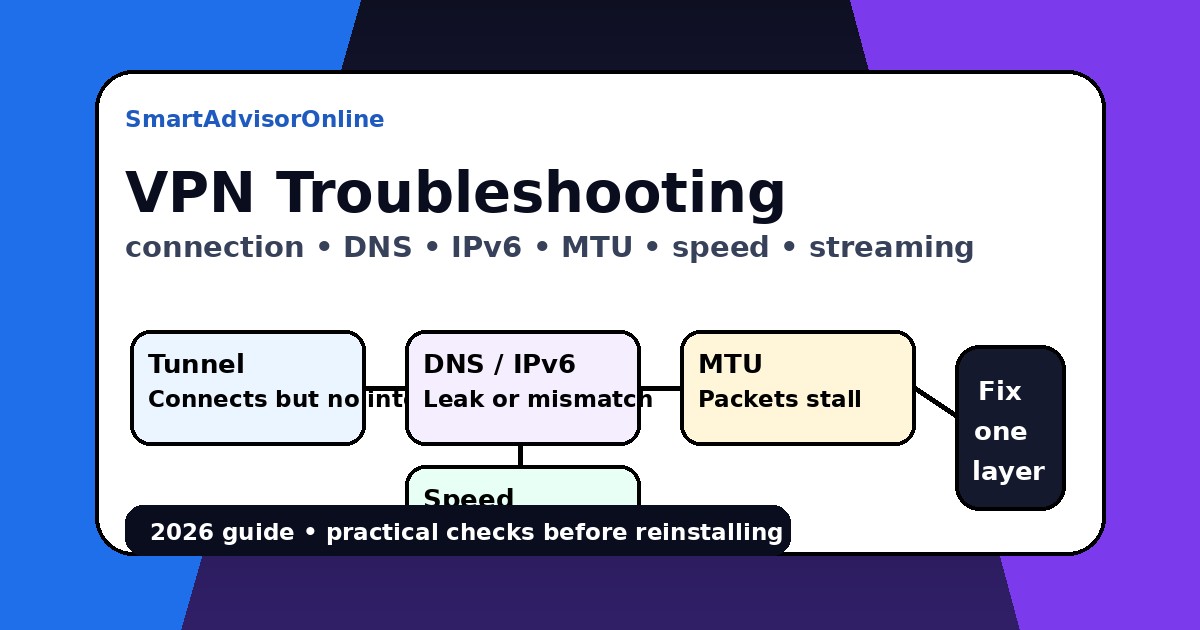
When a VPN fails, most people do the worst possible thing: they change ten settings at once and lose track of what actually helped. The faster method is to treat the problem like a diagnostic chain. First confirm the baseline. Then isolate the failure bucket: protocol, route, DNS, IPv6, MTU, or IP reputation. That is exactly what this page is built to do.
In 2026, VPN failures are rarely "random." Hotel Wi-Fi blocks and office firewalls often target UDP first, some devices keep stale routes after a sleep cycle, and modern streaming platforms combine IP reputation with leak signals. If you need the foundations before the rescue phase, keep What Is VPN, VPN Security Basics, and VPN Setup Guide nearby.
Start with the Magic Fixer below. Pick the exact symptom, run one recovery path, and only then move to the next layer. In practice, the highest-win order is: protocol switch, server change, DNS + IPv6 check, MTU adjustment, and only then deep reinstall work.
Start here: fix VPN problems in the right order
| Symptom | Likely layer | First safe action |
|---|---|---|
| VPN connected but no internet | DNS, kill switch, IPv6 or MTU | Disconnect, test baseline, reconnect, then flush DNS. |
| VPN will not connect | Protocol, firewall, server or app permission | Switch protocol and try a nearby server. |
| VPN is slow | Distance, congestion, protocol overhead or obfuscation | Test baseline speed, then compare with VPN on. |
| Streaming app blocks VPN | IP reputation, cookies, DNS, IPv6 or region mismatch | Check live status, clear app state, then test leaks. |
| Sites partly load or stall | MTU fragmentation or unstable route | Try MTU 1400, then 1350 if needed. |
The Magic Fixer
This is the fastest route from "I'm angry and nothing works" to a clean recovery path. Choose the symptom, pick the operating system, and the widget will build a short step sequence instead of dumping a wall of theory on you.
Network Diagnostics Metadata
This section is the "why" behind the fixer. Error codes are not random labels; they point to specific layers. TAP driver errors usually mean Windows adapter conflicts. Error 807 usually means latency, firewall filtering, or a broken handshake path. DNS_PROBE_FINISHED often points to hijacked or stale resolvers rather than a dead tunnel. The faster you map the error to the right layer, the faster the fix.
There are also OS-specific triggers. On Windows, route tables, DNS cache, and virtual adapters are common suspects. On macOS, sleep/wake cycles and network extension permissions often create weird reconnect behavior. On Android and iOS, battery optimization and per-app networking can silently kill tunnels in the background. If your use case is more specific, the dedicated guides for VPN on Windows, VPN on Mac, VPN on Android, and VPN on iOS help narrow the path.
The MTU & Packet-Loss Visualiser
MTU is one of those settings that most users never touch until they desperately need it. When it is too high for the real path, packets fragment or get dropped, which creates the exact type of broken experience people describe as "VPN connected, but the internet feels haunted."
Check the problem with real tools
The page gives recovery paths, but the fastest confirmation comes from real signals. Run a leak check for IP, DNS, IPv6 and WebRTC. Then run a speed check before and after the tunnel. If the problem only happens on Netflix, Hulu, Disney+, BBC iPlayer or another streaming app, use the streaming diagnostic and status page before changing VPN settings again.
The DNS & IPv6 Leak Radar
Sites, apps, and banking systems do not need your full real IP to know something is wrong. Sometimes a single DNS mismatch or an exposed IPv6 route is enough. That is why leak testing must compare baseline versus VPN ON instead of staring at one result screen in isolation. For the full technical background, keep DNS Leak Protection and VPN Encryption in the same tab stack.
The Streaming Block Escape
Streaming errors are emotional because they hit at the exact moment someone wants a quiet evening. The real fix is still technical: clean IP reputation, clean cookies, and one coherent region story. Below, pick the service error that looks closest to what you see.
The Speed vs. Obfuscation Gauge
Obfuscation is not a free upgrade. It is a trade: better camouflage, lower speed. That trade is perfect on blocked office, campus, and hotel networks. It is usually a mistake when you only need maximum streaming throughput at home.
The Ultimate Error-Code Decrypter
This table is designed for search intent and real panic. Find the code, find the meaning, and apply the immediate action before you overcomplicate the situation.
| Error code / symptom | Meaning | Immediate action | Difficulty |
|---|---|---|---|
| TAP Driver Error | Windows driver conflict or stale virtual adapter | Reinstall TAP/Wintun layer and remove older VPN adapters | Medium |
| Error 807 | Latency, packet loss, or firewall block during handshake | Switch to OpenVPN TCP or a nearer server | Low |
| DNS_PROBE_FINISHED | DNS hijacking or stale resolver path | Flush DNS, remove custom DNS, reconnect through VPN DNS | Low |
| Prime 1042 | Proxy or DNS-country mismatch | Use provider DNS, avoid public 8.8.8.8 overrides, clear app state | Medium |
| Netflix M7111-5059 | Flagged IP reputation / proxy detection | Change server, clear cookies, test a less-crowded location | Low |
| Max: Not in Service Area | Region mismatch or IPv6 leak | Disable IPv6 as a test and rebuild a clean region session | Medium |
| Connected but no internet | Broken route, kill switch rule, DNS, or MTU issue | Protocol switch -> DNS flush -> IPv6 test -> MTU 1400/1350 | Critical |
Video (official)
Prefer a quick walkthrough? This is the official SmartAdvisorOnline video. It loads only after you click.

Fallback: Watch on YouTube
PAA: VPN troubleshooting questions people ask
Related guides
- VPN Not Connecting?
- Speed Test
- DNS Leak Protection
- VPN Kill Switch
- VPN Protocols Comparison
- WireGuard vs NordLynx
- VPN vs Proxy
- VPN vs Firewall
- What Is VPN?
- Why Use VPN?

Written by Denys Shchur
Founder and editor of SmartAdvisorOnline. I test VPN setups, break them on purpose, and then document the shortest working fixes in plain English.
Privacy & Cookies: analytics runs only after consent. See Privacy and Disclosure.
Contact: [email protected]
✓ Leak Test referenced for IP / DNS / IPv6 / WebRTC checks
✓ Speed Test referenced for baseline vs VPN speed checks
✓ Streaming VPN Diagnostic and Status Center added for platform-error context
✓ Source guidance reviewed for VPN configuration, IP/DNS/WebRTC checks, MTU troubleshooting and VPN app trust
Verification date: